The Epistles to the Colossians and to Philemon : a commentary on the Greek text / by James D.G. Dunn
Мова: англійська.Вихідні дані: Grand Rapids, Mich. : Carlisle : William B. Eerdmans Publishing, Paternoster Press, 1996Опис: xvii, 388 pages ; 24 cmISBN: 0802824412; 9780802824417; 085364571; 9780853645719; 9780802872838; 0802872832.Серія: The New international Greek Testament commentaryІндекс Дьюї (ДКД): 227/.7077, 20Класифікація: 11.46 ; 227.7Примітки про зміст: The epistle to the Colossians -- The significance of the letter -- Colossae and the establishment of Christianity there -- The trouble at Colossae -- Who wrote Colossians? -- Where and when was Colossians written? -- The structure of Colossians -- Commentary -- Address and greeting (1:1-2) -- Extended thanksgiving (1:3-23) -- A personal statement (1:24-2:5) -- The theme of the letter (2:6-4:6) -- The thematic statement (2:6-7) -- The cross of Christ renders unnecessary any further human traditions and rules (2:8-23) -- The pattern of living that follows from the cross (3:1-4:6) -- Conclusion (4:7-18) -- The epistle to Philemon -- Introduction -- The author -- The recipient -- The occasion -- The place of writing -- The structure of the letter -- Commentary -- Address and greeting (1-3) -- Thanksgiving and prayer (4-7) -- Appeal to Philemon (8-20) -- In conclusion (21-25) Анотація: Paul's Epistle to the Colossians merits detailed study for at least two reasons. First, it provides an unexpectedly interesting window into the character of Christianity in Asia Minor in the second half of the first century. With the information it gives about the religious tensions within which emergent Christianity was caught up, not least those between Christianity and diaspora Judaism, we begin to gain more insight into the influences and factors that shaped the transition from apostolic to subapostolic Christianity in the region. Second, Colossians represents a crucial stage in the development of Pauline theology itself. Whether it was written at the end of Paul's life or soon after his death, it indicates how Pauline theology retained its own vital character and did not die with Paul. In this volume in the celebrated New International Greek Testament Commentary, James D.G. Dunn, author of numerous well-received works on the historical origin and theological interpretation of the New Testament, provides detailed expositions of the text of Paul's letters to the Colossians and to Philemon. Dunn examines each of these letters within the context of the Jewish and Hellenistic cultures in the first century, and discusses the place of Colossians and Philemon in the relationship between the Pauline mission and the early churches that received these letters. Particular stress is also placed on the role of faith in Jesus Christ within and over against Judaism and on the counsel of these two important letters with regard to the shaping of human relationships in the community of faith..Наявність бібліографії/покажчика: Includes bibliographical references and indexes..Ім’я особи як предметна рубрика: Paulus (Apostel) Kolosserbrief | Paulus (Apostel) Philemonbrief Найменування теми як предметна рубрика: 11.46 study and interpretation of the New Testament | Kommentar | Colossenzen (bijbelboek) | Filemon (bijbelboek) Ресурси он-лайн: Натисніть тут для доступу в онлайн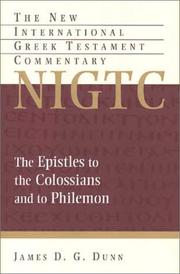
| Тип одиниці зберігання | Поточна бібліотека | Шифр зберігання | Стан | Штрих-код | |
|---|---|---|---|---|---|
 Книги
Книги
|
Бібліотека ТХІ Загальний фонд | 227.7077 D923 (Огляд полиці(Відкривається нижче)) | Доступно | 4317911600 |
Includes bibliographical references and indexes.
The epistle to the Colossians -- The significance of the letter -- Colossae and the establishment of Christianity there -- The trouble at Colossae -- Who wrote Colossians? -- Where and when was Colossians written? -- The structure of Colossians -- Commentary -- Address and greeting (1:1-2) -- Extended thanksgiving (1:3-23) -- A personal statement (1:24-2:5) -- The theme of the letter (2:6-4:6) -- The thematic statement (2:6-7) -- The cross of Christ renders unnecessary any further human traditions and rules (2:8-23) -- The pattern of living that follows from the cross (3:1-4:6) -- Conclusion (4:7-18) --
The epistle to Philemon -- Introduction -- The author -- The recipient -- The occasion -- The place of writing -- The structure of the letter -- Commentary -- Address and greeting (1-3) -- Thanksgiving and prayer (4-7) -- Appeal to Philemon (8-20) -- In conclusion (21-25).
Paul's Epistle to the Colossians merits detailed study for at least two reasons. First, it provides an unexpectedly interesting window into the character of Christianity in Asia Minor in the second half of the first century. With the information it gives about the religious tensions within which emergent Christianity was caught up, not least those between Christianity and diaspora Judaism, we begin to gain more insight into the influences and factors that shaped the transition from apostolic to subapostolic Christianity in the region. Second, Colossians represents a crucial stage in the development of Pauline theology itself. Whether it was written at the end of Paul's life or soon after his death, it indicates how Pauline theology retained its own vital character and did not die with Paul. In this volume in the celebrated New International Greek Testament Commentary, James D.G. Dunn, author of numerous well-received works on the historical origin and theological interpretation of the New Testament, provides detailed expositions of the text of Paul's letters to the Colossians and to Philemon. Dunn examines each of these letters within the context of the Jewish and Hellenistic cultures in the first century, and discusses the place of Colossians and Philemon in the relationship between the Pauline mission and the early churches that received these letters. Particular stress is also placed on the role of faith in Jesus Christ within and over against Judaism and on the counsel of these two important letters with regard to the shaping of human relationships in the community of faith.
Немає коментарів для цієї одиниці.